05 April 2008
More Owls
While doing the annual April Wood duck box clean-out, a "different" resident was discovered...


05 March 2008
Owl Rehab

A few nights ago, my next door neighbor was driving past my house in the dark when an owl struck his mirror. The neighbor stopped to check on the owl, which was still very much alive, and picked it up out of the road to keep it from being crushed. The owl recovered in my neighbor's kitchen from what was probably similar to a concussion. The neighbor let it out an hour later. The owl flew into an apple tree, where it remained for a few minutes, and then flew off, looking healthy. Hopefully, the owl is back on the job controlling rodents.

25 February 2008
Coyote
Took this Coyote on a crisp February afternoon. Over 300 meters, trotting shot with this Remington 7 .203 rifle. Thanks to George and Ann for the push through the apple orchard thicket.


07 January 2008
07 Bucks
This hunting season, two noteworthy bucks were killed at Canoga Creek Farm & Conservancy.


In addition to these fine bucks, 1 six pointer was killed, one spike horn, one button buck, and 3 does. Deer management in progress.


In addition to these fine bucks, 1 six pointer was killed, one spike horn, one button buck, and 3 does. Deer management in progress.
25 December 2007
GEHA - A Mauser conversion 2-shot shotgun
 In the early spring of 2002, when Willis Cosad was packing up the accumulated ephemera of 90 plus years of occupying what would later become Canoga Creek Farms and Conservancy, a decision was made by Willis' son, executor of the Cosad estate, to sell at auction and yard sale all the items not desired by family members. Included in this collection of odds and ends were old farm and shop equipment, including almost one hundred year old stable equipment and tack. Of course there were the expected antique furnishings, and knick knacks, but what caught my eye, especially as I envisioned myself as the new "owner" of the farm and steward of its natural resources and bounty, was an old bolt action shotgun.
I picked up the gun, and Willis' son approached. "That was Dad's goose gun," he said. "It was his favorite." Sold. Though I would have paid significantly more, I acquired the gun for $75.00.

As chance would have it, I had become friends with Nick Tooth, a gunsmith who was responsible for the intricate checkering on the wood for some of the fancy but no longer made Ithaca Classic Doubles (closed their doors in May of 2003--for a brief and incomplete history, click here)
Nick had a look at my prize and quickly pronounced that its future should be as a deer gun. We drilled for some scope mounts, mounted a red dot, and the GEHA has performed well as a big game gun.


Recently, I discovered some research on GEHA published on the web. The article, entitled GEHA, A Little-Known Prime Example of Germany Maintaining its Arms Industry Between the World Wars, sheds additional light on my "deer gun," which I thought would be worth sharing. The following is excerpted from the article: “What on earth is a GEHA?” Simply put, it’s a converted Mauser Gewehr 98 rifle bored out for a 12, 16, or 20 Gauge shotshell, with 1 shell in the magazine plus 1 in the chamber capacity. It is half-stocked, and the wood is usually military grade and was never changed from the Gewehr 98 to the GEHA. It uses a sprung, detachable bolthead that fits over the old Gewehr 98 bolthead, and also utilizes a receiver strengthener/shell deflector that was added because so much metal was removed from the original rifle action. A new trigger assembly and triggerguard were also fitted so as to be more suitable to a shotgun. For one, the triggerguard was quite beefy. For another, the trigger itself was single-stage (as opposed to the two-stage military rifle trigger of the Gewehr 98). These trigger and triggerguard features are shared by the Remo and Hard Hit Heart, the two other Mauser conversion shotguns. Another feature of these guns is that the bolt handles were bent."
"The GEHA was simple. It was cylinder-bored; although a few GEHA’s have been noted with fully-choked bores, they seem to be in a small minority. Frank de Haas notes one of the guns appearing in his book Bolt-Action Rifles co-authored by Dr. Wayne van Zwoll. It retained the military Gewehr 98 stock, and was a no-frills gun without any provisions for a front sling swivel (although it retained the rear swivel mount from the Gewehr 98). The hole for the Gewehr 98’s bolt takedown donut was filled with a medallion reading "GEHA" in script. It was put on the market around 1920 or 1921."
I continue to hunt with this gun today, and am planning to get further information on it, especially specifications I do not have the technology to measure or ascertain, likely with the help of Turnbull restoration, who have done minor work on the gun recently. Those details will be appended to this post. Detailed photos below.


More Geha web resources:
http://www.texastradingpost.com/militaria/geha.html
Guns Magazine May 2008 article
Firearms forum research- very thorough and complete
29 November 2007
Tis the Season...some wildlife humor

This comes from my father, a minister and my original outdoors mentor. Enjoy.
An atheist was walking through the woods.
"What majestic trees!"
"What powerful rivers!"
"What beautiful animals!"
he said to himself.
As he was walking alongside the river, he heard a rustling in the bushes behind him. He turned to look. He saw a 7-foot grizzly bear charge towards him.
He ran as fast as he could up the path. He looked over his shoulder & saw that the bear was closing in on him.
He looked over his shoulder again, & the bear was even closer. He tripped & fell on the ground. He rolled over to pick himself up but saw that the bear was right on top of him, reaching for him with his left paw & raising his right paw to strike him.
At that instant the Atheist cried out, "Oh my God!"
Time Stopped.
The bear froze.
The forest was silent.
As a bright light shone upon the man, a voice came out of the sky. "You deny my existence for all these years, teach others I don't exist and even credit creation to cosmic accident." "Do you expect me to help you out of this predicament? Am I to count you as a believer"?
The atheist looked directly into the light, "It would be hypocritical of me to suddenly ask you to treat me as a Christian now, but perhaps you could make the BEAR a Christian"?
"Very Well," said the voice.
The light went out. The sounds of the forest resumed. And the bear dropped his right paw, brought both paws together, bowed his head & spoke:
"Lord bless this food, which I am about to receive from thy bounty through Christ our Lord, Amen."
18 November 2007

29 October 2007
A Nice Archery Buck

 Yesterday, George H. took a beautiful 11 pt buck out of the Canoga Creek Farm & Conservancy. I won't tell George's story for him in hopes that we will hear from this future Grouser in person on the subject, but suffice it to say that this may be his best archery deer to date, and it is the second "big boy" to grace my lawn since I've been the steward of this here parcel. Hearty congratulations to George.
01 September 2007

06 August 2007


18 May 2007
A New Arrival

Ella, our thoroughbred, was bred to a registered Cleveland Bay stallion almost a year ago. Their lovechild is now munching grass at Canoga Creek Farm & Conservancy. Welcome "Wicca"!!
01 May 2007
Canoga Creek Stocked!!

Recently the newly reinvigorated Finger Lakes Chapter of Trout Unlimited decided to do an experimental stocking of the lovely spring creek called Canoga. Needless to say, the Canoga Creek Farm and Conservancy has been "encouraging" this action for some time now. What can I say, membership to the chapter is inexpensive and a good investment.
So, we have 200 yearling Brown trout (roughly 6 inchers) and 20 two year old brown trout (roughly 14 inchers) newly in the neighborhood. That oughta' keep me busy for awhile.
07 March 2007
Snow Buntings
 Have been noticing pre-migratory flocks of Snow Buntings using the newly established grassland near the lake (you can see it in the background of the ice skating pictures below.) Amazing synchronized flock maneuvers.
For more on Snow Buntings, see http://www.birdsbybent.com/ch91-100/snobunting.html
28 February 2007


22 February 2007

22 December 2006

23 November 2006
A Canoga Creek Thanksgiving II
23 November 2006
4:30 Cocktails
First Course Hors D’oeuvres
Pheasant in a Bramble
Petite Duck a L’orange
Fall Creek Trout Spread and Blue Corn Tortillas
Pepper Jack and Venison Stacks
Rabbit Rouge
Faisan Pate
Grouse Saut?
Cherry Goose
Wine- Swedish Hill Reserve Chardonnay (2003)
Second Course- Soup
Woodcock, Minnesota Wild Rice, and Mushroom Soup
Brie and Baguette
Third/ Main Course
Grilled Wild Turkey Breast with Horseradish Hollandaise
Farm Fresh Turkey Stuffed and Roasted Traditional
Creamed Ginger Garlic Butternut Squash
Mashed Potatoes with Garlic and Parsley
Caribbean Mashed Sweet Potato es
Green Bean Casserole
Chanterelle, Sage and Chestnut Stuffing
Corn Bread and/or Cranberry Orange Bread
Wine- Campo Lagaza, Navarra, Spain (2005)
Fourth Course
Cranberry Parks Glace
Wine- Knapp Vignoles (2005)
Fifth Course
Wild Greens with Bleu Cheese, Cranberry and Walnut Vinaigrette
Sixth Course
Homemade Apple Pie a la mode
Homemade Pumpkin Pie Cake
Homemade Chocolate Pie
Seventh Course-Digestif
Fonseca Guimaraens Vintage Port (1995)
Xocolata Picant, Artesanals La Vall D’Or (Barcelona)
La Gloria Cubana Maduro Cigar
13 November 2006
Property Rights vs. Agland Protection
“It is the policy of this state... to conserve, protect and encourage the development and improvement of agricultural land for the production of food, and other products, and also for its natural and ecological value.” Article 25AA-NYS Agriculture and Markets Law
Background
Recently in Seneca County, New York, a conflict arose between environmental sustainability proponents and property rights advocates. This in itself is in no way surprising. However, because the opposing views were both held by members of the agriculture community, a specific and well organized segment of rural society unified under Farm Bureau, a unique opportunity presents itself to better understand some of the nuances of collisions of property rights advocacy with a particular kind of sustainability and open space preservation that favors continuing agricultural practices.
By way of background, according to a 2001 USDA Economic Research Service report on development impacts on farming[1], development in agricultural districts may cause the following:
Suburban neighbors’ complaints about farm odors and chemical spraying may force farmers to turn to enterprises that produce fewer negative side effects. Some of the alternatives will be more profitable and some will be less.
Conflicts can arise between growers and new suburban neighbors over early morning noise, and increased traffic can hinder farmers’ ability to move their equipment along overcrowded rural roads being used as commuter routes.
Markets for traditional dairy products or field crops may be reduced, as milk-collection routes are curtailed and grain elevators go out of business. In some areas, farm input suppliers, machinery dealers, and other forms of agricultural support may decline.
Real estate taxes may rise as land prices rise to reflect the potential for non-farm development.
Growers may face increased pressure from water- and land-use restrictions.
Farms may face deteriorating crop yields from urban smog, theft, and vandalism.
Farm Bureau at the local and state level supported and favored passage of Article 25AA- NYS Agriculture and Markets Law, commonly called “The Ag Districts Law” and/or “The Right To Farm Law.” [2] The law declared that many of the agricultural lands in New York State are in jeopardy of being lost for any agricultural purposes, and that when nonagricultural development extends into farm areas, competition for limited land resources results. The law also registered concern over ordinances inhibiting farming, rising farm taxes, and hopes for speculative gains that discourage investments in farm improvements, often leading to the idling or conversion of potentially productive agricultural land.
The law makes it the “policy of the state to conserve, protect and encourage the development and improvement of its agricultural land for production of food and other agricultural products.” It is also the declared policy of the state to conserve and protect agricultural lands as valued natural and ecological resources which provide needed open spaces for clean air sheds, as well as for aesthetic purposes.
The legal basis of the law, it was argued at its passage, was that the constitution of the state of New York directs the legislature to provide for the protection of agricultural lands. Therefore, the law was intended to provide a locally-initiated mechanism for the protection and enhancement of New York State's agricultural land as a viable segment of the local and state economies and as an economic and environmental resource of major importance. The problem is, the law anticipated only fending off attacks from the non-farming public. As a result, the law has two major “blind spots” as we shall see shortly.
New York State Agricultural Districts Law
Sixteen different states in the U.S. have developed agricultural district programs. They allow farmers to form special areas where commercial agriculture is encouraged and protected. Participation by farmers is voluntary and in exchange for enrollment, farmers receive packages of benefits including favorable tax treatment, right-to-farm protections and shielding from infrastructure financial assessments. Some states (e.g. Pennsylvania) also make it very difficult to extend public improvements into farm areas that could cause negative impacts on agriculture.
In New York State, an agricultural district is an area containing important agricultural land that is created through petition by farmers and officially designated by a County Legislature. Under provisions of the Agricultural Districts Law as amended, an agricultural district is comprised of 500 or more acres of reasonably contiguous, viable agricultural land. Districts are reviewed every eight years to determine the current extent of agricultural land in the area and to identify whether inclusions or exclusions to the district will be made.
Agricultural District programs offer several strengths as farmland protection tools. These
include the following according to the American Farmland Trust[3] and others:
Agricultural District programs are very flexible; benefits and restrictions can be tailored to local conditions.
Agricultural Districts help stabilize the land base at low public cost.
Agricultural Districts provide multiple benefits to farmers, including tax relief, protection from local regulation and eligibility for purchase of development rights
programs. These benefits help support the economics of farming.
Agricultural Districts help create a critical mass of land to keep farming viable.
Enrollment in Agricultural Districts is voluntary, making the programs popular with farmers.
A landowner in an Agricultural District can take advantage of farmland protection
techniques that would otherwise require agricultural zoning. Such zoning can impose strict restrictions on farmland and is not part of New York's Agricultural District Law, although individual communities can opt to pursue such options as part of their own programs.
These strengths are accompanied by some drawbacks, however. Again, the American Farmland Trust suggests these include:
Sanctions for withdrawing land from agricultural districts may not be strong enough to discourage conversion.
Limits on non-farm development may not prevent expansion of public services such as water and sewer lines into agricultural areas. New York State's Agricultural District Law, fortunately, does address this issue with exemption from special district levies based on frontage and specific planning and notice requirements.
The benefits provided by Agricultural Districts are not always enough incentive for farmers to enroll. Owners must also pay penalties to remove themselves from a District prior to its eight-year term.
The procedure for creating agricultural districts can be lengthy and complex.
More Background-The Specifics of the Seneca County Case
As has been described above, the “Ag Districts Law” seems to protect farmers from undue persecution, and protect farmland from conversion to residential or commercial development. The perpetrators of these “attacks” upon farming are of course assumed to be non-farmers. But what happens when a farmer threatens the future of farmland by pushing to convert his farmland into residential development, and neighboring farmers want to fend off such an attack by invoking the “Ag Districts Law?”
In 2003, a local property owner in Seneca County New York, formerly a farmer, decided that he would provide for his retirement by converting his farmland into residential development lots. After hiring a surveyor and making appropriate drawings, maps, and plans, he approached the Town Planning Board for approval for a major subdivision. The Town is required to hold a Public Hearing for major subdivisions, and at this particular hearing, a significant public outcry ensued over the proposed subdivision. Concerns ranged from the loss of views and open space, to negative effects of sprawl upon neighboring farms, to environmental concerns about overloading a fragile water table with septic systems and consumption of potable water. A petition was circulated and many signatures were collected. The land owner had few people speak in favor of his project.
The town planning board, recognizing the furor of the proposed subdivision, decided to enter into the New York State Environmental Quality Review process using “rigorous” interpretations. The Board found that the environment would potentially be harmed by the major subdivision, and forwarded the opinion to the county planning board. The county, however, found that there would be no significant adverse impact of the conversion of this agricultural land. Taking into consideration the public’s concern with this project, the planning board recommended that the land owner revise his plans to only convert one lot to residential development at that time. The hope was that the planning board, which was nearing the end of writing a comprehensive plan for the town, would be in a better position in the future to deal with land use issues, especially if new zoning were adopted that would protect agricultural land within agricultural districts. In spite of the public outcry over the proposed subdivision, the single lot split was approved.
In 2006, the same farmer appeared again before the town planning board, this time to split off a second lot from his original farm, one of the seven lots proposed in the initial major subdivision proposal. Predictably, the farmer encountered the same adversity, perhaps with even more intensity. This time, the neighboring farmers attempted to invoke the “Ag Districts Law” while appealing to Farm Bureau and county agencies, setting in motion a pitched battle over the intent of agriculture protection laws and opening up new legal questions that remain unanswered.
The Arguments
Attempts to block or forestall conversion of the farm in question originally hinged on two related arguments; 1.) that by virtue of Agricultural Districts law, it was illegal, or at least in violation of both the spirit and the letter of the Agriculture Districts law, especially provisions to protect and preserve farmable land, for the Town Planning Board to approve residential development in a certified agriculture district, even if town zoning did not specifically prohibit it, and 2.) that allowing residential development in an agricultural district where neighboring farms had properly registered their concern through Agriculture Data Statements caused harms to the livelihoods of neighboring farms and violated their “rights to farm,” also protected in the Agriculture Districts Law (AML §305-a).[4]
A third, unique argument to block agriculture land conversion to residential or commercial development was also presented. This argument takes a creative “future tense” interpretation of the “Right to Farm” provision in the Ag Districts law. At issue is the future “Rights to Farm” of future farmers if current farmable land is converted to commercial development. In other words, if I am a 12 year old boy with aspirations of farming in my home county, my “Right to Farm” may be impinged upon if my opportunity to farm is foreclosed by dwindling farmable land in my community.
Arguments supporting a farmer’s inalienable right to do whatever he desires with his land were not particularly new or unique, and followed strict property rights movement rhetoric closely.
Two Blind Spots
Among the threats to agricultural land, one of the largest threats is farmers who, because of development pressures, become real estate speculators and sell their land for commercial or residential development. Despite the noble and well meaning aims of Agricultural Districts Law, it seems that an overarching “problem” with the law is that it does not anticipate conflict between and among farmers about land use decisions within the agriculture community, and therefore has two significant blind spots, which prevent the law from effectively addressing one of the largest threats to farmland.
The first “blind spot” is that there is no language in the law suggesting penalty or punitive damages for violation of Agricultural Districts Law, jurisdiction, or even guidance to municipalities on what they should do to enforce. The second is that the agricultural real estate assessment “penalty upon conversion” provision intended to be a disincentive, is so small as to be meaningless. As a result of these two blind spots, among those who have the most “agency” in terms of the threat of development, there is least enforceability or accountability.
Conclusion
The Ag Districts law limits a town or municipalities ability to restrict or regulate agriculture, but it does not limit a towns’ ability to protect agriculture, even if it protects agriculture from some farmers who want to cash out and sell their farms. Therefore, towns and municipalities should strengthen local “Right to Farm” ordinances and impose significant penalties upon farmers wishing to cash out of agricultural districts, especially if they have reaped tax savings for having been in Ag districts. These penalties could be reduced based upon selling farmers willingness to enter into other farmland preservation programs (percentage of land in easements, PDR/TDR, etc.). This kind of approach will help create locally based agricultural enhancement initiatives that provide both incentives and disincentives in efforts to protect agricultural and open space, while preserving property rights.
[1] http://www.ers.usda.gov/publications/aer803/
[2] http://www.agmkt.state.ny.us/AP/agservices/2004C115.pdf
[3] See: http://www.farmland.org/resources/publications/documents/NewYorkLandownerGuide.pdf
and: http://www.farmland.org/resources/reports/default.asp
[4] http://www.agmkt.state.ny.us/ap/agservices/new305/guidance.pdf
Background
Recently in Seneca County, New York, a conflict arose between environmental sustainability proponents and property rights advocates. This in itself is in no way surprising. However, because the opposing views were both held by members of the agriculture community, a specific and well organized segment of rural society unified under Farm Bureau, a unique opportunity presents itself to better understand some of the nuances of collisions of property rights advocacy with a particular kind of sustainability and open space preservation that favors continuing agricultural practices.
By way of background, according to a 2001 USDA Economic Research Service report on development impacts on farming[1], development in agricultural districts may cause the following:
Suburban neighbors’ complaints about farm odors and chemical spraying may force farmers to turn to enterprises that produce fewer negative side effects. Some of the alternatives will be more profitable and some will be less.
Conflicts can arise between growers and new suburban neighbors over early morning noise, and increased traffic can hinder farmers’ ability to move their equipment along overcrowded rural roads being used as commuter routes.
Markets for traditional dairy products or field crops may be reduced, as milk-collection routes are curtailed and grain elevators go out of business. In some areas, farm input suppliers, machinery dealers, and other forms of agricultural support may decline.
Real estate taxes may rise as land prices rise to reflect the potential for non-farm development.
Growers may face increased pressure from water- and land-use restrictions.
Farms may face deteriorating crop yields from urban smog, theft, and vandalism.
Farm Bureau at the local and state level supported and favored passage of Article 25AA- NYS Agriculture and Markets Law, commonly called “The Ag Districts Law” and/or “The Right To Farm Law.” [2] The law declared that many of the agricultural lands in New York State are in jeopardy of being lost for any agricultural purposes, and that when nonagricultural development extends into farm areas, competition for limited land resources results. The law also registered concern over ordinances inhibiting farming, rising farm taxes, and hopes for speculative gains that discourage investments in farm improvements, often leading to the idling or conversion of potentially productive agricultural land.
The law makes it the “policy of the state to conserve, protect and encourage the development and improvement of its agricultural land for production of food and other agricultural products.” It is also the declared policy of the state to conserve and protect agricultural lands as valued natural and ecological resources which provide needed open spaces for clean air sheds, as well as for aesthetic purposes.
The legal basis of the law, it was argued at its passage, was that the constitution of the state of New York directs the legislature to provide for the protection of agricultural lands. Therefore, the law was intended to provide a locally-initiated mechanism for the protection and enhancement of New York State's agricultural land as a viable segment of the local and state economies and as an economic and environmental resource of major importance. The problem is, the law anticipated only fending off attacks from the non-farming public. As a result, the law has two major “blind spots” as we shall see shortly.
New York State Agricultural Districts Law
Sixteen different states in the U.S. have developed agricultural district programs. They allow farmers to form special areas where commercial agriculture is encouraged and protected. Participation by farmers is voluntary and in exchange for enrollment, farmers receive packages of benefits including favorable tax treatment, right-to-farm protections and shielding from infrastructure financial assessments. Some states (e.g. Pennsylvania) also make it very difficult to extend public improvements into farm areas that could cause negative impacts on agriculture.
In New York State, an agricultural district is an area containing important agricultural land that is created through petition by farmers and officially designated by a County Legislature. Under provisions of the Agricultural Districts Law as amended, an agricultural district is comprised of 500 or more acres of reasonably contiguous, viable agricultural land. Districts are reviewed every eight years to determine the current extent of agricultural land in the area and to identify whether inclusions or exclusions to the district will be made.
Agricultural District programs offer several strengths as farmland protection tools. These
include the following according to the American Farmland Trust[3] and others:
Agricultural District programs are very flexible; benefits and restrictions can be tailored to local conditions.
Agricultural Districts help stabilize the land base at low public cost.
Agricultural Districts provide multiple benefits to farmers, including tax relief, protection from local regulation and eligibility for purchase of development rights
programs. These benefits help support the economics of farming.
Agricultural Districts help create a critical mass of land to keep farming viable.
Enrollment in Agricultural Districts is voluntary, making the programs popular with farmers.
A landowner in an Agricultural District can take advantage of farmland protection
techniques that would otherwise require agricultural zoning. Such zoning can impose strict restrictions on farmland and is not part of New York's Agricultural District Law, although individual communities can opt to pursue such options as part of their own programs.
These strengths are accompanied by some drawbacks, however. Again, the American Farmland Trust suggests these include:
Sanctions for withdrawing land from agricultural districts may not be strong enough to discourage conversion.
Limits on non-farm development may not prevent expansion of public services such as water and sewer lines into agricultural areas. New York State's Agricultural District Law, fortunately, does address this issue with exemption from special district levies based on frontage and specific planning and notice requirements.
The benefits provided by Agricultural Districts are not always enough incentive for farmers to enroll. Owners must also pay penalties to remove themselves from a District prior to its eight-year term.
The procedure for creating agricultural districts can be lengthy and complex.
More Background-The Specifics of the Seneca County Case
As has been described above, the “Ag Districts Law” seems to protect farmers from undue persecution, and protect farmland from conversion to residential or commercial development. The perpetrators of these “attacks” upon farming are of course assumed to be non-farmers. But what happens when a farmer threatens the future of farmland by pushing to convert his farmland into residential development, and neighboring farmers want to fend off such an attack by invoking the “Ag Districts Law?”
In 2003, a local property owner in Seneca County New York, formerly a farmer, decided that he would provide for his retirement by converting his farmland into residential development lots. After hiring a surveyor and making appropriate drawings, maps, and plans, he approached the Town Planning Board for approval for a major subdivision. The Town is required to hold a Public Hearing for major subdivisions, and at this particular hearing, a significant public outcry ensued over the proposed subdivision. Concerns ranged from the loss of views and open space, to negative effects of sprawl upon neighboring farms, to environmental concerns about overloading a fragile water table with septic systems and consumption of potable water. A petition was circulated and many signatures were collected. The land owner had few people speak in favor of his project.
The town planning board, recognizing the furor of the proposed subdivision, decided to enter into the New York State Environmental Quality Review process using “rigorous” interpretations. The Board found that the environment would potentially be harmed by the major subdivision, and forwarded the opinion to the county planning board. The county, however, found that there would be no significant adverse impact of the conversion of this agricultural land. Taking into consideration the public’s concern with this project, the planning board recommended that the land owner revise his plans to only convert one lot to residential development at that time. The hope was that the planning board, which was nearing the end of writing a comprehensive plan for the town, would be in a better position in the future to deal with land use issues, especially if new zoning were adopted that would protect agricultural land within agricultural districts. In spite of the public outcry over the proposed subdivision, the single lot split was approved.
In 2006, the same farmer appeared again before the town planning board, this time to split off a second lot from his original farm, one of the seven lots proposed in the initial major subdivision proposal. Predictably, the farmer encountered the same adversity, perhaps with even more intensity. This time, the neighboring farmers attempted to invoke the “Ag Districts Law” while appealing to Farm Bureau and county agencies, setting in motion a pitched battle over the intent of agriculture protection laws and opening up new legal questions that remain unanswered.
The Arguments
Attempts to block or forestall conversion of the farm in question originally hinged on two related arguments; 1.) that by virtue of Agricultural Districts law, it was illegal, or at least in violation of both the spirit and the letter of the Agriculture Districts law, especially provisions to protect and preserve farmable land, for the Town Planning Board to approve residential development in a certified agriculture district, even if town zoning did not specifically prohibit it, and 2.) that allowing residential development in an agricultural district where neighboring farms had properly registered their concern through Agriculture Data Statements caused harms to the livelihoods of neighboring farms and violated their “rights to farm,” also protected in the Agriculture Districts Law (AML §305-a).[4]
A third, unique argument to block agriculture land conversion to residential or commercial development was also presented. This argument takes a creative “future tense” interpretation of the “Right to Farm” provision in the Ag Districts law. At issue is the future “Rights to Farm” of future farmers if current farmable land is converted to commercial development. In other words, if I am a 12 year old boy with aspirations of farming in my home county, my “Right to Farm” may be impinged upon if my opportunity to farm is foreclosed by dwindling farmable land in my community.
Arguments supporting a farmer’s inalienable right to do whatever he desires with his land were not particularly new or unique, and followed strict property rights movement rhetoric closely.
Two Blind Spots
Among the threats to agricultural land, one of the largest threats is farmers who, because of development pressures, become real estate speculators and sell their land for commercial or residential development. Despite the noble and well meaning aims of Agricultural Districts Law, it seems that an overarching “problem” with the law is that it does not anticipate conflict between and among farmers about land use decisions within the agriculture community, and therefore has two significant blind spots, which prevent the law from effectively addressing one of the largest threats to farmland.
The first “blind spot” is that there is no language in the law suggesting penalty or punitive damages for violation of Agricultural Districts Law, jurisdiction, or even guidance to municipalities on what they should do to enforce. The second is that the agricultural real estate assessment “penalty upon conversion” provision intended to be a disincentive, is so small as to be meaningless. As a result of these two blind spots, among those who have the most “agency” in terms of the threat of development, there is least enforceability or accountability.
Conclusion
The Ag Districts law limits a town or municipalities ability to restrict or regulate agriculture, but it does not limit a towns’ ability to protect agriculture, even if it protects agriculture from some farmers who want to cash out and sell their farms. Therefore, towns and municipalities should strengthen local “Right to Farm” ordinances and impose significant penalties upon farmers wishing to cash out of agricultural districts, especially if they have reaped tax savings for having been in Ag districts. These penalties could be reduced based upon selling farmers willingness to enter into other farmland preservation programs (percentage of land in easements, PDR/TDR, etc.). This kind of approach will help create locally based agricultural enhancement initiatives that provide both incentives and disincentives in efforts to protect agricultural and open space, while preserving property rights.
[1] http://www.ers.usda.gov/publications/aer803/
[2] http://www.agmkt.state.ny.us/AP/agservices/2004C115.pdf
[3] See: http://www.farmland.org/resources/publications/documents/NewYorkLandownerGuide.pdf
and: http://www.farmland.org/resources/reports/default.asp
[4] http://www.agmkt.state.ny.us/ap/agservices/new305/guidance.pdf
20 October 2006
Farm Bureau 06 Resolution
Whereas, 1. Farmland in Seneca County is increasingly threatened by conversion to residential development, 2. Seneca County Agriculture Enhancement Plans and NYS Ag & Markets Laws are intended to protect farmers from unplanned residential development that may harm their agricultural operations’ viability, 3. Farmers in Seneca County who have recently relied upon NYS Ag & Markets Agricultural Districts and Right to Farm laws to protect their interests have been ill served,
Be it resolved that the Seneca County Farm Bureau:
1. Calls urgently upon New York State Farm Bureau to work with NYS Department of Agriculture and Markets to re-evaluate Agricultural Districts Law and to clarify enforcement of the law and penalties for violation of these critical laws.
2. Encourages New York State Farm Bureau to create a model Local Right-to-Farm law for use by local municipalities.
3. Recommends a participatory state-wide process in which New York State Farm Bureau members can become involved in a dialogue about the tensions between, on one hand, fundamental property rights and retirement or near retirement aged farmers’ strategies to sell their land for development, and on the other hand, the need to protect dwindling farmland resources in Seneca County and across the state for future farmers.
Be it resolved that the Seneca County Farm Bureau:
1. Calls urgently upon New York State Farm Bureau to work with NYS Department of Agriculture and Markets to re-evaluate Agricultural Districts Law and to clarify enforcement of the law and penalties for violation of these critical laws.
2. Encourages New York State Farm Bureau to create a model Local Right-to-Farm law for use by local municipalities.
3. Recommends a participatory state-wide process in which New York State Farm Bureau members can become involved in a dialogue about the tensions between, on one hand, fundamental property rights and retirement or near retirement aged farmers’ strategies to sell their land for development, and on the other hand, the need to protect dwindling farmland resources in Seneca County and across the state for future farmers.
18 September 2006
House passes Horse Slaughter Prevention Act
In a disappointing vote, the U.S. House of Representatives passed a Farm Bureau-opposed bill, HR 503, the Horse Slaughter Prevention Act. This legislation would set a negative precedent by banning a livestock product for reasons other than food safety or public health. There has been no action on the Senate companion bill, S. 1915. Only Representatives Boehlert, Higgins, and McHugh voted “no” on this onerous bill. The remaining members of New York’s congressional delegation instead listened to emotional rhetoric from animal rights groups and supported passage of this legislation. Although animal rights activists claim that the Horse Slaughter Prevention Act is an animal welfare bill, its passage would actually be seriously detrimental to the humane care and treatment of horses. The unintended consequence of eliminating this humane euthanasia option for horses would result in leaving as many as 100,000 horses each year to neglect and abandonment.
01 September 2006

31 August 2006
Reform Ag trade?
USDA Secretary Johanns said recently "that (US Farm Trade Policy) reform is necessary because current farm supports distribute much money to relatively few large producers and for selected crops that produce relatively little revenue, thereby unintentionally raising the prices of land and capital, and discouraging young people from entering agriculture."
Huh. From this administration? Johanns for President.
For more of the story, click here
Huh. From this administration? Johanns for President.
For more of the story, click here
25 August 2006
Making outlaws of us all
From the ASI newsletter:
New Regs for Transporting Hay
Under the Public Health Security and Bioterrorism Preparedness and Response Act of 2002, regulations regarding the transporting of hay will go into effect in December. The new rules are designed to protect against serious threats to the food supply. The regulations relate only to transported hay that is destined to be fed to livestock entering the nation's food chain, such as beef and dairy cattle, sheep and goats. All size farms are affected, but those who grow hay exclusively for use in their own livestock operation will see no change in procedures.
The regulations state that specific documentation must be kept by farmers if they sell, barter, give away or otherwise ship hay destined for use as livestock feed off the originating farm. If someone else does the hauling, the responsibility for record keeping shifts to the transporter. The Food and Drug Administration (FDA) considers transporters to be anyone who has possession or control of an article of food for the sole purpose of transporting it by rail, road, water or air. The FDA requires that records concerning animal food be kept for one year. Currently, a standard bill of lading provides most of this information.
New Regs for Transporting Hay
Under the Public Health Security and Bioterrorism Preparedness and Response Act of 2002, regulations regarding the transporting of hay will go into effect in December. The new rules are designed to protect against serious threats to the food supply. The regulations relate only to transported hay that is destined to be fed to livestock entering the nation's food chain, such as beef and dairy cattle, sheep and goats. All size farms are affected, but those who grow hay exclusively for use in their own livestock operation will see no change in procedures.
The regulations state that specific documentation must be kept by farmers if they sell, barter, give away or otherwise ship hay destined for use as livestock feed off the originating farm. If someone else does the hauling, the responsibility for record keeping shifts to the transporter. The Food and Drug Administration (FDA) considers transporters to be anyone who has possession or control of an article of food for the sole purpose of transporting it by rail, road, water or air. The FDA requires that records concerning animal food be kept for one year. Currently, a standard bill of lading provides most of this information.
02 August 2006
GOVERNOR ANNOUNCES NEW ETHANOL PRODUCTION FACILITY TO BE CONSTRUCTED AT THE SENECA ARMY DEPOT
Well, we did it. This was a "sticky wicket." Turned the train around, kept it from stopping in Seneca Falls permanetly, but kept it from leaving Seneca County. Seneca County wins, Agriculture wins, and the Environment wins. Next item...
See: http://www.state.ny.us/governor/press/06/0801061.html
See: http://www.state.ny.us/governor/press/06/0801061.html
20 July 2006
Grass on my mind...
While making hay, I recalled a quote I read somewhere about grass and Sampson...I found it and here it is.
"I have always had real affection for grass. It seems to stand for quietness and strength. I believe that the quietness and strength of grass should be, must be permanently a part of our agriculture if this nation is to have the strength it will need in the future. A countryside shorn and stripped of thick, green grass, it seems to me, is weakened just as Sampson was. An agriculture without grass loses a primary source of strength."
- Henry A. Wallace in 1940 (quoted in H.A. Wallace Institute for Alternative Agriculture 1992:5)
For an intersting read on grass based ag, see:
http://www.cias.wisc.edu/foodshed/pubsntools/grass.htm
"I have always had real affection for grass. It seems to stand for quietness and strength. I believe that the quietness and strength of grass should be, must be permanently a part of our agriculture if this nation is to have the strength it will need in the future. A countryside shorn and stripped of thick, green grass, it seems to me, is weakened just as Sampson was. An agriculture without grass loses a primary source of strength."
- Henry A. Wallace in 1940 (quoted in H.A. Wallace Institute for Alternative Agriculture 1992:5)
For an intersting read on grass based ag, see:
http://www.cias.wisc.edu/foodshed/pubsntools/grass.htm
07 June 2006
25 May 2006

18 May 2006
Breaking News...

We purchased two more registered angus heifers at the New York State Empire Heifer Development program sale. That brings the breeding herd size to 4 registered angus plus 5 commercial angus cross cows for a total of 9 cows plus 6 steers.
05 May 2006
Farm Typology
Fresh from ERS at USDA-
Farm typology
The Economic Research Service (ERS) has developed a farm classification to divide U.S. farms into eight mutually exclusive and more homogeneous groups. The farm typology focuses on "family farms," or farms organized as proprietorships, partnerships, and family corporations that are not operated by a hired manager. To be complete, however, it also includes nonfamily farms. A collapsed farm typology combines the eight groups into three categories.
Small Family Farms (sales less than $250,000)
Limited-resource farms. Any small farm with: (1) gross sales less than $100,000, (2) total farm assets less than $150,000, and (3) total operator household income less than $20,000. Limited-resource farmers may report farming, a nonfarm occupation, or retirement as their major occupation.
Retirement farms. Small farms whose operators report they are retired (excludes limited-resource farms operated by retired farmers).
Residential/lifestyle farms. Small farms whose operators report they had a major occupation other than farming (excludes limited-resource farms with operators reporting a nonfarm major occupation).
Farming occupation/lower-sales. Small farms with sales less than $100,000 whose operators report farming as their major occupation (excludes limited-resource farms whose operators report farming as their major occupation).
Farming occupation/high-sales. Small farms with sales between $100,000 and $249,999 whose operators report farming as their major occupation.
Other Farms
Large family farms. Farms with sales between $250,000 and $499,999.
Very large family farms. Farms with sales of $500,000 or more.
Nonfamily farms. Farms organized as nonfamily corporations or cooperatives, as well as farms operated by hired managers.
For further details on the collapsed farm typology, see Food and Agricultural Policy—Taking Stock for the New Century (Appendix 1).
Collapsed Farm Typology
The collapsed farm typology combines the eight farm typology groups into three categories:
Rural residence farms. Includes limited-resource, retirement, and residential lifestyle farms.
Intermediate farms. Includes farming occupation/lower-sales and farming occupation/higher-sales farms.
Commercial farms. Includes large, very large, and nonfamily farms.
Farm typology
The Economic Research Service (ERS) has developed a farm classification to divide U.S. farms into eight mutually exclusive and more homogeneous groups. The farm typology focuses on "family farms," or farms organized as proprietorships, partnerships, and family corporations that are not operated by a hired manager. To be complete, however, it also includes nonfamily farms. A collapsed farm typology combines the eight groups into three categories.
Small Family Farms (sales less than $250,000)
Limited-resource farms. Any small farm with: (1) gross sales less than $100,000, (2) total farm assets less than $150,000, and (3) total operator household income less than $20,000. Limited-resource farmers may report farming, a nonfarm occupation, or retirement as their major occupation.
Retirement farms. Small farms whose operators report they are retired (excludes limited-resource farms operated by retired farmers).
Residential/lifestyle farms. Small farms whose operators report they had a major occupation other than farming (excludes limited-resource farms with operators reporting a nonfarm major occupation).
Farming occupation/lower-sales. Small farms with sales less than $100,000 whose operators report farming as their major occupation (excludes limited-resource farms whose operators report farming as their major occupation).
Farming occupation/high-sales. Small farms with sales between $100,000 and $249,999 whose operators report farming as their major occupation.
Other Farms
Large family farms. Farms with sales between $250,000 and $499,999.
Very large family farms. Farms with sales of $500,000 or more.
Nonfamily farms. Farms organized as nonfamily corporations or cooperatives, as well as farms operated by hired managers.
For further details on the collapsed farm typology, see Food and Agricultural Policy—Taking Stock for the New Century (Appendix 1).
Collapsed Farm Typology
The collapsed farm typology combines the eight farm typology groups into three categories:
Rural residence farms. Includes limited-resource, retirement, and residential lifestyle farms.
Intermediate farms. Includes farming occupation/lower-sales and farming occupation/higher-sales farms.
Commercial farms. Includes large, very large, and nonfamily farms.
27 April 2006
On The Farm
On The Farm
There was Dai Puw. He was no good.
They put him in the fields to dock swedes,
And took the knife from him, when he came home
At late evening with a grin
Like the slash of a knife on his face.
There was Llew Puw, and he was no good.
Every evening after the ploughing
With the big tractor he would sit in his chair,
And stare into the tangled fire garden,
Opening his slow lips like a snail.
There was Huw Puw, too. What shall I say?
I have heard him whistling in the hedges
On and on, as though winter
Would never again leave those fields,
And all the trees were deformed.
And lastly there was the girl:
Beauty under some spell of the beast.
Her pale face was the lantern
By which they read in life's dark book
The shrill sentence: God is love.
R.S. Thomas
There was Dai Puw. He was no good.
They put him in the fields to dock swedes,
And took the knife from him, when he came home
At late evening with a grin
Like the slash of a knife on his face.
There was Llew Puw, and he was no good.
Every evening after the ploughing
With the big tractor he would sit in his chair,
And stare into the tangled fire garden,
Opening his slow lips like a snail.
There was Huw Puw, too. What shall I say?
I have heard him whistling in the hedges
On and on, as though winter
Would never again leave those fields,
And all the trees were deformed.
And lastly there was the girl:
Beauty under some spell of the beast.
Her pale face was the lantern
By which they read in life's dark book
The shrill sentence: God is love.
R.S. Thomas
18 April 2006

17 March 2006
...what about urban agriculture?
I wonder if the community gardens in New Orleans would qualify for funds...
March 15, 2006: The U. S. Department of Agriculture's (USDA) Farm Service Agency (FSA) will allocate close to $20.1 million in Emergency Conservation Program (ECP) funding to 26 states affected by natural disasters. ECP gives producers resources to remove debris from farmland, restore fences and conservation structures, provide water for livestock in drought situations and grade and shape farmland damaged by a natural disaster. For details, see http://www.agweb.com/get_article.asp?pageid=125948&src=agnews
March 15, 2006: The U. S. Department of Agriculture's (USDA) Farm Service Agency (FSA) will allocate close to $20.1 million in Emergency Conservation Program (ECP) funding to 26 states affected by natural disasters. ECP gives producers resources to remove debris from farmland, restore fences and conservation structures, provide water for livestock in drought situations and grade and shape farmland damaged by a natural disaster. For details, see http://www.agweb.com/get_article.asp?pageid=125948&src=agnews
01 March 2006
06 February 2006
Small Farming 101
Life on a small farm might seem primitive, but by living such a life we become able to discover the Great Path. I believe that one who deeply respects his neighborhood and everyday world in which he lives will be shown the greatest of all worlds.
~ Masanobu Fukuoka ~
~ Masanobu Fukuoka ~
Small Farm Nostalgia?
New York Times
February 5, 2006
Op-Ed Contributor
Nebraska's Nostalgia Trap
By RICHARD DOOLING, Omaha
ON average, Nebraska's economy is doing just fine. But a man whose head is in the oven and whose feet are in the freezer takes no comfort in knowing that his average body temperature is perfectly normal. In the same vein, a casual glance at a graph of Nebraska's population growth shows slow, steady increases, going all the way back to 1900, and conceals the fact that 74 of Nebraska's 93 counties are in extremis, with lower populations today than they had in 1920.
Over a third of the state's 1.7 million residents live in greater Omaha, which is booming by many measures, including population growth. According to Ernie Goss, an economist at Creighton University here, Omaha is growing faster than Des Moines, Kansas City and St. Louis.
What about the rest of Nebraska? Well, it's big: over 77,000 square miles (about 10 percent bigger than the six New England states combined) and 450 miles wide, roughly the distance from Boston to the District of Columbia. Most of the economic growth occurs along the thoroughfares that form what local economists call "the fishhook": Highway 275 from Omaha to Norfolk being the hook, and Interstate 80 from Omaha to Colorado being the stem.
Outside of Omaha and the fishhook, large parts of Nebraska are arguably in trouble. The dismal statistic that trends lower, year after year, for many of these struggling counties, is population.
Farms double in size with a regularity that rivals the seasons, while, almost in tandem, the number of farming families falls by half. The costs for schools, roads and police and fire departments remain relatively constant, but the bodies paying taxes, buying goods and developing land keep disappearing. County officials call it rural flight, brain drain or even mass migration, but despite the alarums, nobody has found a way to stop the excursions.
States like Iowa, Kansas, Minnesota, Missouri, North Dakota, Oklahoma and Wisconsin have tried to fight the trend by restricting the corporate consolidation of farms: Keep the farmers on their land by stopping vast corporations from buying 10 farms and consolidating them into one, which is basically what keeps happening.
In 1982, Nebraska went even farther and embedded a ban on corporations owning and operating farms — Initiative 300 — in its Constitution. Last December, a federal judge in Omaha ruled that the ban violates the Commerce Clause of the United States Constitution and the Americans with Disabilities Act (because the ban also requires that the person owning most of the farmland also supply most of the daily labor). Some Nebraskans hope the ruling will be overturned, but that seems unlikely.
Opponents of these laws, which purport to protect family farmers, view them as economic nostalgia — like trying to protect the local paper by banning Internet news sites and mandating that the newspaper be delivered by a towheaded kid on a bicycle. If rank protectionism is not the solution, then what is?
Doug German, executive director of Legal Aid of Nebraska, who lives in the central part of the state, just off the fishhook, in Eustis (pop. 425), and provides legal services to the casualties of the state's poorer counties, agrees that rural Nebraska is at a "tipping point." The antidote to its economic depopulation, he believes, does not lie in bringing Intel or Toyota factories to the heartland, but in Nebraskans resolutely blooming where they are planted and developing micro industries capable of flourishing anywhere, with the help of computer and Internet technologies.
I hope Mr. German is right, but I wonder what kind of micro industry will save the likes of Arthur County (half the size of Rhode Island), where the population peaked at 1,412 in 1920, was 442 in 2000, and 402 in 2004? In these parts, during election season, the signs along the road say "Vote for Helen, County Assessor," because there's only one Helen, and she's running unopposed.
Instead of micro industries, a cynical futurist might see mega-farms, owned by global corporations, and farmed by armies of robot combines, controlled by global positioning satellite technology from offices in Omaha.
Richard Dooling is a screenwriter and the author, most recently, of "Bet Your Life."
Copyright 2006 The New York Times Company
February 5, 2006
Op-Ed Contributor
Nebraska's Nostalgia Trap
By RICHARD DOOLING, Omaha
ON average, Nebraska's economy is doing just fine. But a man whose head is in the oven and whose feet are in the freezer takes no comfort in knowing that his average body temperature is perfectly normal. In the same vein, a casual glance at a graph of Nebraska's population growth shows slow, steady increases, going all the way back to 1900, and conceals the fact that 74 of Nebraska's 93 counties are in extremis, with lower populations today than they had in 1920.
Over a third of the state's 1.7 million residents live in greater Omaha, which is booming by many measures, including population growth. According to Ernie Goss, an economist at Creighton University here, Omaha is growing faster than Des Moines, Kansas City and St. Louis.
What about the rest of Nebraska? Well, it's big: over 77,000 square miles (about 10 percent bigger than the six New England states combined) and 450 miles wide, roughly the distance from Boston to the District of Columbia. Most of the economic growth occurs along the thoroughfares that form what local economists call "the fishhook": Highway 275 from Omaha to Norfolk being the hook, and Interstate 80 from Omaha to Colorado being the stem.
Outside of Omaha and the fishhook, large parts of Nebraska are arguably in trouble. The dismal statistic that trends lower, year after year, for many of these struggling counties, is population.
Farms double in size with a regularity that rivals the seasons, while, almost in tandem, the number of farming families falls by half. The costs for schools, roads and police and fire departments remain relatively constant, but the bodies paying taxes, buying goods and developing land keep disappearing. County officials call it rural flight, brain drain or even mass migration, but despite the alarums, nobody has found a way to stop the excursions.
States like Iowa, Kansas, Minnesota, Missouri, North Dakota, Oklahoma and Wisconsin have tried to fight the trend by restricting the corporate consolidation of farms: Keep the farmers on their land by stopping vast corporations from buying 10 farms and consolidating them into one, which is basically what keeps happening.
In 1982, Nebraska went even farther and embedded a ban on corporations owning and operating farms — Initiative 300 — in its Constitution. Last December, a federal judge in Omaha ruled that the ban violates the Commerce Clause of the United States Constitution and the Americans with Disabilities Act (because the ban also requires that the person owning most of the farmland also supply most of the daily labor). Some Nebraskans hope the ruling will be overturned, but that seems unlikely.
Opponents of these laws, which purport to protect family farmers, view them as economic nostalgia — like trying to protect the local paper by banning Internet news sites and mandating that the newspaper be delivered by a towheaded kid on a bicycle. If rank protectionism is not the solution, then what is?
Doug German, executive director of Legal Aid of Nebraska, who lives in the central part of the state, just off the fishhook, in Eustis (pop. 425), and provides legal services to the casualties of the state's poorer counties, agrees that rural Nebraska is at a "tipping point." The antidote to its economic depopulation, he believes, does not lie in bringing Intel or Toyota factories to the heartland, but in Nebraskans resolutely blooming where they are planted and developing micro industries capable of flourishing anywhere, with the help of computer and Internet technologies.
I hope Mr. German is right, but I wonder what kind of micro industry will save the likes of Arthur County (half the size of Rhode Island), where the population peaked at 1,412 in 1920, was 442 in 2000, and 402 in 2004? In these parts, during election season, the signs along the road say "Vote for Helen, County Assessor," because there's only one Helen, and she's running unopposed.
Instead of micro industries, a cynical futurist might see mega-farms, owned by global corporations, and farmed by armies of robot combines, controlled by global positioning satellite technology from offices in Omaha.
Richard Dooling is a screenwriter and the author, most recently, of "Bet Your Life."
Copyright 2006 The New York Times Company
24 January 2006
A reason...
...for those who must ask why.
"If you assume that there is no hope, you guarantee that there will be
no hope. If you assume that there is an instinct for freedom, that
there are opportunities to change things, then there is a possibility
that you can contribute to making a better world. That's your choice."
-N. Chomsky
"If you assume that there is no hope, you guarantee that there will be
no hope. If you assume that there is an instinct for freedom, that
there are opportunities to change things, then there is a possibility
that you can contribute to making a better world. That's your choice."
-N. Chomsky
19 January 2006


16 January 2006
New York Oak
“NEW YORK OAK” may appear on wine labels in the near future, thanks to an experiment by the innovative and iconoclastic winemaker at Lakewood Vineyards, Chris Stamp, who is now aging wine in barrels made from white oak harvested in New York State. The concept is the ultimate in “terroir”: using oak from the same basic climate that affects the vineyards. The barrels arrived this fall, but it will be some time before the wines in them will be released. (Wine Press Dec 30)
10 January 2006
04 January 2006
Preserving the Land a 2006 NY Farm Bureau Priority
This is a huge victory in and of itself, for those of us that have been working hard on this issue for some time. Now, we can REALLY get to work!
New York Farm Bureau
Priority Issue 2006
Preserving the Land
New York communities receive environmental, social and economic benefits from the working landscapes created by agriculture. New York farms can only continue to provide these benefits through the implementation of public policy that supports farm profitability and stability. This includes the recognition that land resources, as a necessary and vital part of the farm operation, need to be protected and that all efforts should be made to maintain them in agriculture. The authority for local establishment of agricultural districts is one example of previous positive legislation that protects farm businesses.
Inherent to maintaining the viability of a farm operation is being able to depend on the land resource. This certainty was thrown into question last year under a Supreme Court decision which determined essentially, that because another private business may ultimately pay more in taxes, farmland can be taken through eminent domain proceedings and given to that business. Not addressing this decision means that New York will continue to have fundamentally flawed policy that may not recognize private property rights at the most basic level and limits any effort to grow one of New York’s largest industries.
All too often in land-use planning, agriculture is not made a priority. This fact, combined with well intentioned, but poorly designed, land-use tools actually encourages open-space destruction. As areas of New York face increasing development pressure, efforts need to be made to ensure that local officials understand the importance of agriculture and provide land-use regulations that effectively promote farm businesses. These officials also need to be provided with tools and funds necessary to preserve farmland in the community.
Farmers are proud to serve as the stewards of many of our natural resources and work hard to take care of the land. However, they have a large task and need assistance to implement best management practices that protect our environment, but that may not add to the financial viability of the businesses. Helping farms protect the land is essential to the sustainability of New York agriculture and New York communities.
Recommendations
· Support an amendment to the State Constitution banning the use of eminent domain to acquire land for economic development purposes. Advocate for changes to New York’s Eminent Domain Procedure Law that strengthen the protections provided land owners involved in the eminent domain process.
· Work for further enhancement of the Environmental Protection Fund and respective increases in agriculture related EPF programs and categories.
· Require that local officials dealing with land-use issues receive sound basic training and that a curriculum on agricultural land-use be developed.
· Authorize municipalities, with local voter support, to increase the real estate transfer tax up to two percent, to provide funding support for farmland preservation projects.
· Removal of the capital gains tax required on the sale of farmland development rights sold for conservation and preservation purposes.
· Enact statute recognizing that timber should be considered tangible property for the purposes of assessment values.
New York Farm Bureau
Priority Issue 2006
Preserving the Land
New York communities receive environmental, social and economic benefits from the working landscapes created by agriculture. New York farms can only continue to provide these benefits through the implementation of public policy that supports farm profitability and stability. This includes the recognition that land resources, as a necessary and vital part of the farm operation, need to be protected and that all efforts should be made to maintain them in agriculture. The authority for local establishment of agricultural districts is one example of previous positive legislation that protects farm businesses.
Inherent to maintaining the viability of a farm operation is being able to depend on the land resource. This certainty was thrown into question last year under a Supreme Court decision which determined essentially, that because another private business may ultimately pay more in taxes, farmland can be taken through eminent domain proceedings and given to that business. Not addressing this decision means that New York will continue to have fundamentally flawed policy that may not recognize private property rights at the most basic level and limits any effort to grow one of New York’s largest industries.
All too often in land-use planning, agriculture is not made a priority. This fact, combined with well intentioned, but poorly designed, land-use tools actually encourages open-space destruction. As areas of New York face increasing development pressure, efforts need to be made to ensure that local officials understand the importance of agriculture and provide land-use regulations that effectively promote farm businesses. These officials also need to be provided with tools and funds necessary to preserve farmland in the community.
Farmers are proud to serve as the stewards of many of our natural resources and work hard to take care of the land. However, they have a large task and need assistance to implement best management practices that protect our environment, but that may not add to the financial viability of the businesses. Helping farms protect the land is essential to the sustainability of New York agriculture and New York communities.
Recommendations
· Support an amendment to the State Constitution banning the use of eminent domain to acquire land for economic development purposes. Advocate for changes to New York’s Eminent Domain Procedure Law that strengthen the protections provided land owners involved in the eminent domain process.
· Work for further enhancement of the Environmental Protection Fund and respective increases in agriculture related EPF programs and categories.
· Require that local officials dealing with land-use issues receive sound basic training and that a curriculum on agricultural land-use be developed.
· Authorize municipalities, with local voter support, to increase the real estate transfer tax up to two percent, to provide funding support for farmland preservation projects.
· Removal of the capital gains tax required on the sale of farmland development rights sold for conservation and preservation purposes.
· Enact statute recognizing that timber should be considered tangible property for the purposes of assessment values.
28 December 2005
To Ponder on the Way Out The Door...

"It is not the critic who counts: not the man who points out how the strong man stumbles or where the doer of deeds could have done better. The credit belongs to the man who is actually in the arena, whose face is marred by dust and sweat and blood, who strives valiantly, who errs and comes up short again and again, because there is no effort without error or shortcoming, but who knows the great enthusiasms, the great devotions, who spends himself for a worthy cause; who, at the best, knows, in the end, the triumph of high achievement, and who, at the worst, if he fails, at least he fails while daring greatly, so that his place shall never be with those cold and timid souls who knew neither victory nor defeat."
T. Roosevelt
"Citizenship in a Republic," Speech at the Sorbonne, Paris, April 23, 1910
22 December 2005
Natural Links in a Long Chain of Being
Natural Links in a Long Chain of Being by Victor Hanson
Classics and military history scholar Victor Hanson is a professor emeritus at California State University, Fresno, and a senior fellow at the Hoover Institution. His family farm includes 40 acres of seedless grapes grown for raisins. Hanson hopes his son, William, will succeed him in tending the farm.
"I believe there is an old answer for every new problem, that wise whispers of the past are with us to assure us that… we are not alone." Morning Edition, December 19, 2005 ·
I believe we are not alone.Even if I am on the other side of the world from the farmhouse I live in, I still dream of the ancient vines out the window, and the shed out back that my grandfather's father built in 1870 with eucalyptus trunks. As long as I can recreate these images, I never quite leave home. I don't think farming in the same place for six generations is a dead weight that keeps you shackled, doing the identical thing year in and year out. Instead, it is a rare link to others before me, who pruned the same vines and painted the same barn that I have. If those in this house survived the Panic of 1893 or the Great Depression, or bathed with cold water and used an outhouse, then surely I know I can weather high gas prices. I believe that all of us need some grounding in our modern world of constant moving, buying, selling, meeting and leaving. Some find constancy in religion. Others lean on friends or community for permanence. But we need some daily signposts that we are not novel, not better, not worse from those who came before us.
For me, this house, this farm, these ancient vines are those roots. Although I came into this world alone and will leave alone, I am not alone.
There are ghosts of dozens of conversations in the hallways, stories I remember about buying new plows that now rust in the barnyard and ruined crops from the same vines that we are now harvesting.
I believe all of us are natural links in a long chain of being, and that I need to know what time of day it is, what season is coming, whether the wind is blowing north or from the east, and if the moon is still full tomorrow night, just as the farmers who came before me did.
The physical world around us constantly changes, but human nature does not. We must struggle in our brief existence to find some transcendent meaning during reoccurring heartbreak and disappointment and so find solace in the knowledge that our ancestors have all gone through this before.
You may find all that all too intrusive, living with the past as present. I find it exhilarating. I believe there is an old answer for every new problem, that wise whispers of the past are with us to assure us that if we just listen and remember, we are not alone; we have been here before.
Classics and military history scholar Victor Hanson is a professor emeritus at California State University, Fresno, and a senior fellow at the Hoover Institution. His family farm includes 40 acres of seedless grapes grown for raisins. Hanson hopes his son, William, will succeed him in tending the farm.
"I believe there is an old answer for every new problem, that wise whispers of the past are with us to assure us that… we are not alone." Morning Edition, December 19, 2005 ·
I believe we are not alone.Even if I am on the other side of the world from the farmhouse I live in, I still dream of the ancient vines out the window, and the shed out back that my grandfather's father built in 1870 with eucalyptus trunks. As long as I can recreate these images, I never quite leave home. I don't think farming in the same place for six generations is a dead weight that keeps you shackled, doing the identical thing year in and year out. Instead, it is a rare link to others before me, who pruned the same vines and painted the same barn that I have. If those in this house survived the Panic of 1893 or the Great Depression, or bathed with cold water and used an outhouse, then surely I know I can weather high gas prices. I believe that all of us need some grounding in our modern world of constant moving, buying, selling, meeting and leaving. Some find constancy in religion. Others lean on friends or community for permanence. But we need some daily signposts that we are not novel, not better, not worse from those who came before us.
For me, this house, this farm, these ancient vines are those roots. Although I came into this world alone and will leave alone, I am not alone.
There are ghosts of dozens of conversations in the hallways, stories I remember about buying new plows that now rust in the barnyard and ruined crops from the same vines that we are now harvesting.
I believe all of us are natural links in a long chain of being, and that I need to know what time of day it is, what season is coming, whether the wind is blowing north or from the east, and if the moon is still full tomorrow night, just as the farmers who came before me did.
The physical world around us constantly changes, but human nature does not. We must struggle in our brief existence to find some transcendent meaning during reoccurring heartbreak and disappointment and so find solace in the knowledge that our ancestors have all gone through this before.
You may find all that all too intrusive, living with the past as present. I find it exhilarating. I believe there is an old answer for every new problem, that wise whispers of the past are with us to assure us that if we just listen and remember, we are not alone; we have been here before.
20 December 2005
Luke's Way -Coda
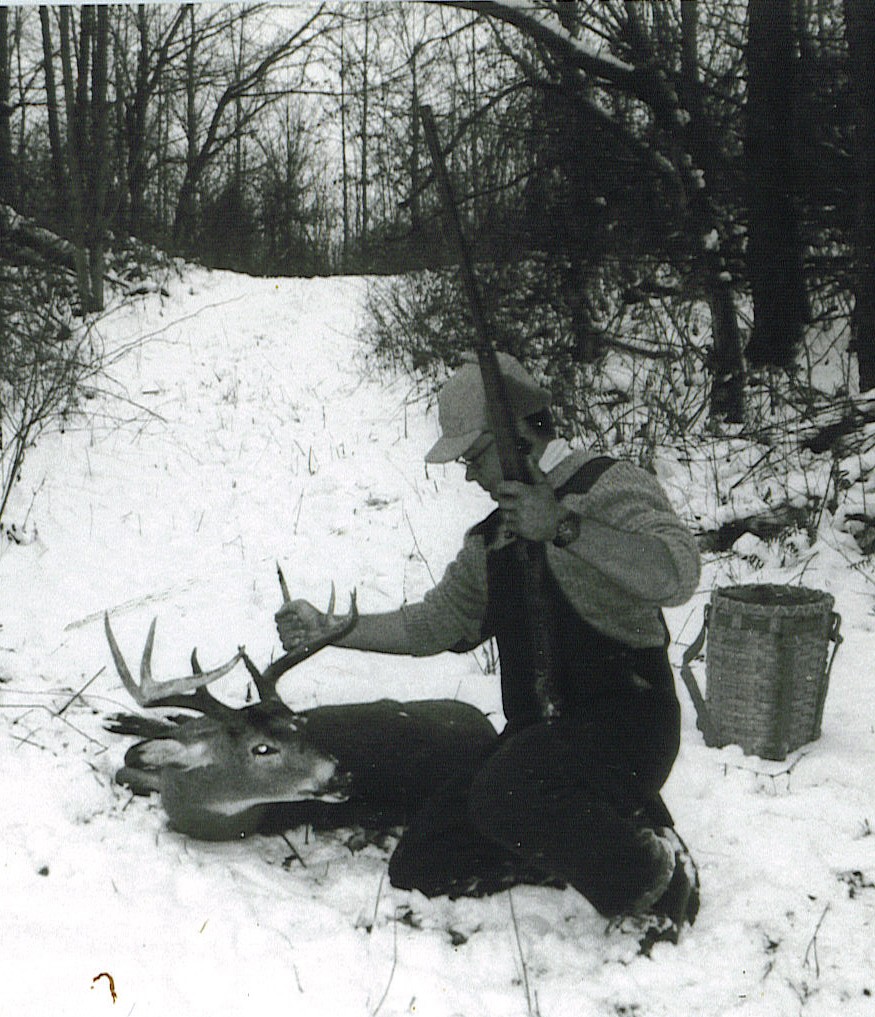
The last day of deer season for me was a Monday. Luke and Rob left Sunday morning for Kentucky, and I decided Sunday evening to get out for just a few hours on the last day. I was still basking in the afterglow of the memorable squirrel hunt turned deer hunt and feeling relieved and thankful that the weekend was a success for Luke, and for me also. I once again awoke before dawn, but more gladly than in days past, moving in that mode of savoring the last day of something, be it a vacation, a season like summer, or whatever one looks forward to for longer than one can actually enjoy. I was clearly savoring the last day of deer season. Putting on my orange coat, which thankfully was becoming just slightly less jarring in its vividness. Grabbing a handful of slug shells out of the cigar box, picking up the old deer gun. It occurred to me that I might want to “keep my luck” and not switch guns, owing to the recent success of the “magical gun of mystery,” but I scoffed at my hunting mysticism and superstition and reminded myself that this was just a couple of hours on the last day. So I settled on the bolt action WWI relic and headed out the door.
My destination was the O’Connor tree stand, not 50 yards from where the gray doe came to rest Saturday. It is a comfortable stand, easy to get to quickly in the snow, and over the years, incredibly productive, or so I had been told. To date I found it to be excellent for ground squirrel observation.
As I settled in I took my habitual deep breaths and closed my eyes, listening for a few minutes. It was beautifully quiet. Even more snow had fallen in the night. A Great Horned Owl announced the end of his shift, and a gentle breeze made the tree sway slowly. I opened my eyes and there was a bit more daylight. The trees looked like they had been lightly moistened and dipped into confectioners sugar, creating a fantasy quality in the gully where one might expect to be visited by the Sugar Plum Fairy or Old Saint Nick at any moment. I chuckled at this thought, preferring rather a gift of a different sort on this last morning of deer season.
Yet, I was aware of my inner voice encouraging me to avoid being greedy, especially as Christmas approached. So I rested my mind on the gift I had been given by Luke, by hunting Luke’s way. I replayed the dinner conversation where Luke innocently rescued me from wallowing in self-pity, a perfectly ridiculous waste of emotion, especially during hunting season. Turning my head slightly, I scanned the ridge top where we had stood, looking down at the fleeing doe. Slowly turning my head still further, exaggerating deliberateness, I surveyed the area where she was bedded, where she began her ascent up the far ridge, and where she fell. And then I froze.
Simultaneously I saw motion in the extreme periphery to my right and heard twigs snapping. “Too loud and too cold for the ground squirrels” I thought. The problem was, due to my reminiscent rubber-necking a moment ago, I was now in need of a more than 180 degree adjustment of my field of view. I began the super slow revolution of my head upon its axis of my slightly cramped neck. Gradually, in the periphery of my left eye, one doe appeared, then three, then five then more than I could easily count. They were moving quickly from left to right. I was thinking to myself, “Well now, what an embarrassment of riches…which one shall I concentrate upon?” Just as I was about to raise my gun, the does seemed to hear something behind them, which caused a domino effect of snorting and tail and ear twitching. They began to move further to my right at a trot, looking as if they might slip over the little ridge to the west without offering me much of a shot, especially if I didn’t hurry. And then I saw two more deer coming fast out of some brambles from the left, two that had been lagging behind the larger groups of does apparently.
The lead deer seemed smallish, the second appearing larger, but her head has concealed behind the first. “Ok” I thought “slowly raise the gun, just wait for them to pass into your field of fire, and take the second deer.” I raised the gun, aware of a faint sound of fabric rubbing. I remember hearing a belch-like grunt and thinking “Strange…that second doe just burped” and then feeling like I might have been injected with a few cc’s of straight caffeine intravenously. At about the same moment, all of the moisture previously existing in my throat and mouth was forced as if by a press directly out of the pores in my hands, my heart rate spiked like the NASDAQ at the birth of the phrase “dot com” and, oddly, I was aware of the sound an overloaded transistor makes before exploding, that high pitched note that keeps getting higher. All of this because I was witnessing a natural history miracle; the belching trailing doe raised her head and became a magnificent nine point buck before my very eyes.
The miracle buck was trailing the doe in heat with a purpose, and they were moving quickly. Everything was moving quickly, and paradoxically, ever so slowly. As I watched the buck extend his neck and head to better understand the doe’s tail, it was as if I had been given wildlife footage and was being afforded an opportunity to leisurely observe the film frame by frame. In this frame, hmm, interesting, look at that moss hanging of off those antlers. In the next, oh, I see, they were down in the little bog…look at all of that mucky mud on her and all that pond scum and vegetation on his front legs. In the next frame, well, extraordinary, those antler beams look thick as axe handles from the rear view. And then the film was speeded up, fast forward style as I became aware that I could no longer see the doe and would quickly lose sight of the buck. He was escaping me after passing at twenty yards. For some still unknown reason, I whistled, as if hailing a taxi, and then said “Hey!” The buck pulled up short, and stood stock still for a second or two. I was aware that if I clenched my jaw any harder I would break a molar. He turned his head to the right, eliminating the back of the skull shot I had just set up, but giving me a fair neck shot if I could readjust quickly. I re-targeted none too smoothly, in a fast, overly law enforcement-esque fashion, saw the red dot settle in, and touched the trigger. At the report of the gun, the miracle buck went directly down, and I remember exhaling, or was it inhaling, as if I had nearly drowned but made the surface at the last second. The sound of my gasp startled me more than the report of the gun. The powdered sugar on the small trees where the buck now lay was sliding off of the branches and sprinkling down over the animal’s massive head and antlers.
The buck unofficially “green-scored” darn close to 140, which is big news for me and my neighbors, but probably won’t make the local papers, and surely won’t make the big book. Yet sitting here now, basking in the magic of my family at Christmas and thinking back to the fairy dust sprinkling on the miracle buck’s head, I know the real story. I know that the deer campaign I set out upon on opening day, the “year of the buck” obsession that drove me to measuring the enjoyment of my hunts by the presence or lack of quantitative accomplishments and achievements, wasn’t hunting. I learned that taking a young person out to have an adventure, or sharing the woods and waters with a friend, or that taking “me” and my need for success out of the equation and putting the focus on relationships with companions, with the game, the worthy quarry, and with all that is wild or desires to be, is hunting. I know that the way of hunting, the ways of predator and prey, are paths sometimes hidden from us. And I know that Luke’s way, the young boy’s way of noticing but perhaps not judging, is a good way to avoid becoming lost while on these paths. I know that in hunting, as in life, things don’t always go our way. And that’s okay
08 December 2005
Luke's Way Part 4
My name was called kneeling under that oak tree looking at squirrel sign with Luke and his father. Rob later said my expression was really like I, but nobody else, heard perhaps my wife calling my name or the phone ringing. Luke asked �What?� and I put my finger to my lips. I was suddenly very alert, but still unsure why, or what called me. We kneeled silently together for a moment, and I remember how beautifully quiet it was, and how lovely the faint rustling of the dead oak leaves still on the branches sounded. Luke and Rob were looking at me intently, like I was either going to tell a joke punch line or break some bad news. Instead, I smiled and slowly, deliberately, removed the three bird shot shells from the �magical gun of mystery�, and replaced them with three deer slugs. I wasn�t sure why.
From the squirrel�s vantage point high in the swaying branches of the oak tree, this is what he saw. Directly below him, at the base of his tree on the ridge, were three humans with guns, nothing unusual this time of the year, crouching, looking at his acorn peelings and footprints, pointing here and there. The squirrel barked warnings to them, declaring his rights to privacy and property so that they will leave the place where he has buried a nut or two. Far below the squirrel, down in the ravine, in the blackberry bramble on the far side of the creek, rest three does, their ears twitching, nostrils flaring, puzzling out mixed signals on the wind. They are laying low in the snow where they often seek refuge, riding out the winter weather in the shelter of the gully. The humans with guns often walk past them where they lay quietly. This day they snort nervously, aware of a predator, of impending danger. The sounds and smells are strong, though intermittent. They decide to depart quickly.
Meanwhile, on the ridge the squirrel sees the human with the orange coat rise and motion to the other two to follow him. The little one follows next, followed by the one with no hat. The squirrel turns his gaze again to the deer, now standing up in the snow, twitching their tails and snorting. One is big and gray, one is slightly smaller and more tan, and one is younger and tan colored. Looking back at the humans, the squirrel sees that they are walking towards the edge of the ravine, to a clear spot recently logged. The deer are moving now toward a switchback trail up the far side of the ravine, running. The humans have reached the edge of the ravine. The little one is pointing at the running deer and the one in the orange coat is snapping his gun up to his cheek. Bang! The squirrel drops his nut and dives into his tree home, where he is greeted by the noisy chatter of his tree mates.
I shot three times, the �magical gun of mystery� performing flawlessly for once. I lowered the gun and it registered that I had just seen deer and shot at them. I heard a squirrel chattering. On my left I heard Rob say, �You got �im,� incredulously. �We got a deer!� Luke exclaimed. At first I couldn�t see anything. We were standing side by side by side on the ridge in the fading light as the snow fell. Then I could see a big gray doe laying on the deer trail across the creek about 120 yards down and away. She was still. Two other deer were running up the trail, pausing for a moment looking back, cresting the rim and bounding out of the gorge and out of sight.
I turned my head and looked at Rob and Luke, who were smiling. �I am going to the deer,� I said. �Would you gentleman mind keeping your eye on it from here in case she gets up, or I can�t see her from down there in the thick stuff? I�ll give you a shout to come down when I get to her.� We all agreed to the plan, and as I excitedly and hurriedly slid down on my backside down the snowy ravine (which I must remember to do again as it was quite exhilarating!), I could hear Luke speaking with exuberance to his father. While chambering a few shells in case the deer was not finished, I resolved then to do all I could to help Luke own this hunt.
As I feared, it was difficult to see anything in the tall brambles, and slowly I picked my way through the brush. I called to Luke, �Luke, can you still see her? Am I getting close?� Simultaneously, both Rob and Luke answered. Luke said �Yep, you�re almost there,� while Rob said �Keep going, a little to your right.� Then, after a few more steps, I saw the gray fur and white tail. When I got to her, she was quite still and dead. I called for Luke and Rob to come down, and emptied the shells from my gun. I leaned the gun in a low fork of a tree, and knelt down to my downed deer. I felt for her wound and finally found an entrance and exit wound in the neck, where the lead slug had severed her spine. She died almost instantly. No wonder she disappeared from view so quickly, which also better explained my instinctive second two shots at the other bigger deer.
Luke and Rob came up behind me and I could hear Luke saying �Wow, it�s bigger than I thought.� I was feeling her fur, and I invited Luke to check it out. It was then that I felt that �performance pressure� ease away from me, and a feeling of immense gratitude came over me. I realized how fortunate we all were to experience this, in this unique way, together. I became aware of how fortunate I was to be hunting in such a beautiful place that happened to be my back yard. And it occurred to me to impress upon Luke the importance of gratitude versus gloating when we have the good fortune of our hunt including a kill. I looked at Rob, and he communicated without words his deference in this situation, which is a compliment to another, as any father knows. I said �Can I get serious for a minute with Luke?� Rob said �Yes, of course.� So I said to Luke, �Remember how I said in hunting, as in life, things don�t always go our way? Well, today they went your way Luke, and my way too. We killed a deer. Now, we must be thankful for this deer, for this life we have taken. We don�t have to do anything fancy, we should just be quiet for a minute and think about this beautiful deer in this beautiful place and be thankful.� After a few moments as we knelt around this gray doe in the snow, giving thanks how we each saw fit, I heard a squirrel�s chatter from the big oak tree up on the ridge. I looked at Luke. �Kind of a strange squirrel hunt, huh Luke?� He had a shy look, turned his head away. �Yeah� he said, sort of laughing.
I asked Rob to go up to the house and get my butchering equipment and some baling twine from the sheep barn while Luke and I found a small lodge pole. While we waited for Rob�s return, we sat on a log and had target practice with the .22 on an old tree trunk that had gnarls in it that looked like the rings of a target paper with a bull�s eye. Luke showed that he was a pretty good shot. We ran out of rounds for the .22 just as Rob appeared up on the ridge. As he was picking his way down to us in the fading winter afternoon light, Luke said �This is the best hunting trip I have ever been on.�
�Sorry we didn�t get you a squirrel� I said.
�Well, getting a deer is pretty good too� he replied.
�Yes,� I said, �because deer are pretty smart.�
We laughed as we stood to greet Rob, having returned from his mission.
Working quickly, we had the deer field dressed before dark, and we hung it from the lodge pole just like in the Davy Crocket books I read when I was a kid. Rob took the front, I took the rear, and the successful hunting party labored under the load of the heavy doe up the path to the top of the ridge as darkness fell. As we approached the farmhouse, we could see the warm yellow lights of the windows and we could all imagine the cheery fires and food, fun, and family waiting for us inside. My children and wife, as well as Rob�s wife and daughter were waiting at the door for us when we returned, and I couldn�t help thinking I was in a Currier and Ives dream state, or that Norman Rockwell would be sitting with his easel in the yard.
So, despite not having shot a trophy buck, my deer drought ended on a happier than could have been expected note. From what I hear, Luke is still telling his New York deer hunting tale. I never told Rob about how preposterous it was that an instinctual snap shot on a running deer at over one hundred yards down hill in bad light with a dubious gun shooting 2 � shells through a stuck poly choke last set for ducks with two witnesses resulting in an instant kill neck shot was. That it was unbelievably lucky, never repeatable, I mean. Not that it wasn�t meant to be. I have told Rob that the hunt I shared with he and his son was one of the most memorable hunts, if not moments, of my life. I am hoping Luke will be willing to go after squirrels with me on my next trip for Moose in Maine or Elk in the Rockies. I hope that in life, as in hunting, things will continue to go Luke�s way.
From the squirrel�s vantage point high in the swaying branches of the oak tree, this is what he saw. Directly below him, at the base of his tree on the ridge, were three humans with guns, nothing unusual this time of the year, crouching, looking at his acorn peelings and footprints, pointing here and there. The squirrel barked warnings to them, declaring his rights to privacy and property so that they will leave the place where he has buried a nut or two. Far below the squirrel, down in the ravine, in the blackberry bramble on the far side of the creek, rest three does, their ears twitching, nostrils flaring, puzzling out mixed signals on the wind. They are laying low in the snow where they often seek refuge, riding out the winter weather in the shelter of the gully. The humans with guns often walk past them where they lay quietly. This day they snort nervously, aware of a predator, of impending danger. The sounds and smells are strong, though intermittent. They decide to depart quickly.
Meanwhile, on the ridge the squirrel sees the human with the orange coat rise and motion to the other two to follow him. The little one follows next, followed by the one with no hat. The squirrel turns his gaze again to the deer, now standing up in the snow, twitching their tails and snorting. One is big and gray, one is slightly smaller and more tan, and one is younger and tan colored. Looking back at the humans, the squirrel sees that they are walking towards the edge of the ravine, to a clear spot recently logged. The deer are moving now toward a switchback trail up the far side of the ravine, running. The humans have reached the edge of the ravine. The little one is pointing at the running deer and the one in the orange coat is snapping his gun up to his cheek. Bang! The squirrel drops his nut and dives into his tree home, where he is greeted by the noisy chatter of his tree mates.
I shot three times, the �magical gun of mystery� performing flawlessly for once. I lowered the gun and it registered that I had just seen deer and shot at them. I heard a squirrel chattering. On my left I heard Rob say, �You got �im,� incredulously. �We got a deer!� Luke exclaimed. At first I couldn�t see anything. We were standing side by side by side on the ridge in the fading light as the snow fell. Then I could see a big gray doe laying on the deer trail across the creek about 120 yards down and away. She was still. Two other deer were running up the trail, pausing for a moment looking back, cresting the rim and bounding out of the gorge and out of sight.
I turned my head and looked at Rob and Luke, who were smiling. �I am going to the deer,� I said. �Would you gentleman mind keeping your eye on it from here in case she gets up, or I can�t see her from down there in the thick stuff? I�ll give you a shout to come down when I get to her.� We all agreed to the plan, and as I excitedly and hurriedly slid down on my backside down the snowy ravine (which I must remember to do again as it was quite exhilarating!), I could hear Luke speaking with exuberance to his father. While chambering a few shells in case the deer was not finished, I resolved then to do all I could to help Luke own this hunt.
As I feared, it was difficult to see anything in the tall brambles, and slowly I picked my way through the brush. I called to Luke, �Luke, can you still see her? Am I getting close?� Simultaneously, both Rob and Luke answered. Luke said �Yep, you�re almost there,� while Rob said �Keep going, a little to your right.� Then, after a few more steps, I saw the gray fur and white tail. When I got to her, she was quite still and dead. I called for Luke and Rob to come down, and emptied the shells from my gun. I leaned the gun in a low fork of a tree, and knelt down to my downed deer. I felt for her wound and finally found an entrance and exit wound in the neck, where the lead slug had severed her spine. She died almost instantly. No wonder she disappeared from view so quickly, which also better explained my instinctive second two shots at the other bigger deer.
Luke and Rob came up behind me and I could hear Luke saying �Wow, it�s bigger than I thought.� I was feeling her fur, and I invited Luke to check it out. It was then that I felt that �performance pressure� ease away from me, and a feeling of immense gratitude came over me. I realized how fortunate we all were to experience this, in this unique way, together. I became aware of how fortunate I was to be hunting in such a beautiful place that happened to be my back yard. And it occurred to me to impress upon Luke the importance of gratitude versus gloating when we have the good fortune of our hunt including a kill. I looked at Rob, and he communicated without words his deference in this situation, which is a compliment to another, as any father knows. I said �Can I get serious for a minute with Luke?� Rob said �Yes, of course.� So I said to Luke, �Remember how I said in hunting, as in life, things don�t always go our way? Well, today they went your way Luke, and my way too. We killed a deer. Now, we must be thankful for this deer, for this life we have taken. We don�t have to do anything fancy, we should just be quiet for a minute and think about this beautiful deer in this beautiful place and be thankful.� After a few moments as we knelt around this gray doe in the snow, giving thanks how we each saw fit, I heard a squirrel�s chatter from the big oak tree up on the ridge. I looked at Luke. �Kind of a strange squirrel hunt, huh Luke?� He had a shy look, turned his head away. �Yeah� he said, sort of laughing.
I asked Rob to go up to the house and get my butchering equipment and some baling twine from the sheep barn while Luke and I found a small lodge pole. While we waited for Rob�s return, we sat on a log and had target practice with the .22 on an old tree trunk that had gnarls in it that looked like the rings of a target paper with a bull�s eye. Luke showed that he was a pretty good shot. We ran out of rounds for the .22 just as Rob appeared up on the ridge. As he was picking his way down to us in the fading winter afternoon light, Luke said �This is the best hunting trip I have ever been on.�
�Sorry we didn�t get you a squirrel� I said.
�Well, getting a deer is pretty good too� he replied.
�Yes,� I said, �because deer are pretty smart.�
We laughed as we stood to greet Rob, having returned from his mission.
Working quickly, we had the deer field dressed before dark, and we hung it from the lodge pole just like in the Davy Crocket books I read when I was a kid. Rob took the front, I took the rear, and the successful hunting party labored under the load of the heavy doe up the path to the top of the ridge as darkness fell. As we approached the farmhouse, we could see the warm yellow lights of the windows and we could all imagine the cheery fires and food, fun, and family waiting for us inside. My children and wife, as well as Rob�s wife and daughter were waiting at the door for us when we returned, and I couldn�t help thinking I was in a Currier and Ives dream state, or that Norman Rockwell would be sitting with his easel in the yard.
So, despite not having shot a trophy buck, my deer drought ended on a happier than could have been expected note. From what I hear, Luke is still telling his New York deer hunting tale. I never told Rob about how preposterous it was that an instinctual snap shot on a running deer at over one hundred yards down hill in bad light with a dubious gun shooting 2 � shells through a stuck poly choke last set for ducks with two witnesses resulting in an instant kill neck shot was. That it was unbelievably lucky, never repeatable, I mean. Not that it wasn�t meant to be. I have told Rob that the hunt I shared with he and his son was one of the most memorable hunts, if not moments, of my life. I am hoping Luke will be willing to go after squirrels with me on my next trip for Moose in Maine or Elk in the Rockies. I hope that in life, as in hunting, things will continue to go Luke�s way.
30 November 2005
Luke's Way Part 3
Luke is an interesting young fellow, thoughtful, sincere, and comical in an off-the-wall kind of way. Luke looked at his father and seeing no sign to maintain silence, furrowed his brow and declared �Huh. Well, deer are pretty smart.� Never truer words were spoken. The boy had just delivered a simple yet profound nugget of truth to me in taking the attention off of myself and my misery and my woe-is-me deer-less pity party and putting the focus squarely where it belonged, on the honorable and magnificent quarry I was after and the reality that hunting deer should not be easy. I smiled and laughed a little, and so did Luke and Rob, but uncomfortably. Apparently, I was wearing this all on my sleeve. I needed to remedy the ambiguous tension in the air.
�Luke, in hunting, as in life, things don�t always go our way. Right now, I am a little discouraged because I have put a lot of thought, time, and effort into getting a deer, and I haven�t got one yet. Most everybody I know has gotten at least a doe or two by now, and many have gotten a buck. I guess I have been feeling a little sorry for myself because I haven�t had a fairy tale deer season where I got a trophy buck on the first day. But, like you said, deer are pretty smart, and I will keep trying. I am glad you are here, and we will go squirrel hunting tomorrow morning, and see what we can do. Are you prepared?�
Luke�s eyes got a little wider and his voice a little higher as he listed all of the things he had done in preparation for his hunt. His enthusiasm elated the mood in the room and the rest of the evening was relaxed for the grown ups, and full of anticipation for Luke, who decided to �turn in early� to be ready for the morning hunt. The fires died in the fireplaces, the wine gave out, and conversation waned. We retired with a steady snow falling.
The next morning I did not awake before dawn as was my usual routine, because squirrel hunting need not be that kind of affair. We all ate a leisurely breakfast, carried a little wood for the kitchen fireplace, and drank coffee and hot chocolate. We went scouting for squirrels, did some farm chores, and before we knew it, it was 2:00 PM. I had forgotten how civilized life could be at such a pace, what with the water fowling season and deer season rigors. Finally, according to Luke, we turned our full attention to the squirrel hunt.
We adjourned to the gun room and began dressing for the field, bundling up against the dropping temperatures outside. Luke was going to borrow my .22, and Rob and I each carried 12 gauge shotguns �to help out� Luke. Rob�s gun for the day was a New England Firearms single shot, mine was a FieldMaster pump, named the �magical gun of mystery� in honor of its often idiosyncratic ways, especially in the duck blind. Would it cycle, would it fire? One never knew. I thought I�d give it a run since I had recently cleaned it good. My hope was that this would be a good barn gun, an extra shotgun to have around, used more as a tool than as an instrument of sporting leisure. It was the right gun for the day.
Luke loaded a pocket full of .22 rounds into his hunting coat, and I grabbed a handful of number sevens. �These ought to do the trick for backing Luke up,� I thought, smiling at the remembrance of my first boyhood squirrel which mysteriously had more than one hole in it despite the fact that I only shot my .22 once. My glance skimmed across a wooden cigar box which held my deer hunting slug shells. �Better grab a couple of these, too, just in case,� I said out loud, noticing a definite increase in my optimism levels. Luke grinned at me.
We crunched through the fresh snow past the barns toward the creek ravine. The ridges over looking the ravine are dotted with 100 year old oak trees that are in decline and full of large cavities. They are like housing projects for gray squirrels. We arrived at the biggest of these, which stands guard over the trail that descends the steep banks of the gully. The ravine is gorge-like in places, with depths of up to 70 feet from the ridge to the creek bottom below. One can only see the creek bottom by standing on the very edge of the ravine and peering over the edge. Adding the 100 plus feet of height of the oak trees, the squirrels are afforded quite a vantage point indeed.
On this day, a squirrel was noisily gnawing away at something in the higher branches. We spotted him high above, a silhouette against the gray sky. �Too far, too high� Rob explained to Luke, taking advantage of an opportunity to explain how rifle bullets travel, even .22�s, and how we must anticipate how far past what we shoot at our bullets will fly. We observed the copious squirrel sign on the snow covered ground, and we bent down studying the comings and goings of our quarry. Luke asked about the blurred tracks, and we spoke of the wind, and the snow, and how animals react to severe weather. And then it happened. It was subtle, almost the same feeling you have when you have been in the waiting room at the doctor�s for hours, and have become drowsy and resigned to forever waiting, and then your name is called. It is both startling and no surprise at all.
�Luke, in hunting, as in life, things don�t always go our way. Right now, I am a little discouraged because I have put a lot of thought, time, and effort into getting a deer, and I haven�t got one yet. Most everybody I know has gotten at least a doe or two by now, and many have gotten a buck. I guess I have been feeling a little sorry for myself because I haven�t had a fairy tale deer season where I got a trophy buck on the first day. But, like you said, deer are pretty smart, and I will keep trying. I am glad you are here, and we will go squirrel hunting tomorrow morning, and see what we can do. Are you prepared?�
Luke�s eyes got a little wider and his voice a little higher as he listed all of the things he had done in preparation for his hunt. His enthusiasm elated the mood in the room and the rest of the evening was relaxed for the grown ups, and full of anticipation for Luke, who decided to �turn in early� to be ready for the morning hunt. The fires died in the fireplaces, the wine gave out, and conversation waned. We retired with a steady snow falling.
The next morning I did not awake before dawn as was my usual routine, because squirrel hunting need not be that kind of affair. We all ate a leisurely breakfast, carried a little wood for the kitchen fireplace, and drank coffee and hot chocolate. We went scouting for squirrels, did some farm chores, and before we knew it, it was 2:00 PM. I had forgotten how civilized life could be at such a pace, what with the water fowling season and deer season rigors. Finally, according to Luke, we turned our full attention to the squirrel hunt.
We adjourned to the gun room and began dressing for the field, bundling up against the dropping temperatures outside. Luke was going to borrow my .22, and Rob and I each carried 12 gauge shotguns �to help out� Luke. Rob�s gun for the day was a New England Firearms single shot, mine was a FieldMaster pump, named the �magical gun of mystery� in honor of its often idiosyncratic ways, especially in the duck blind. Would it cycle, would it fire? One never knew. I thought I�d give it a run since I had recently cleaned it good. My hope was that this would be a good barn gun, an extra shotgun to have around, used more as a tool than as an instrument of sporting leisure. It was the right gun for the day.
Luke loaded a pocket full of .22 rounds into his hunting coat, and I grabbed a handful of number sevens. �These ought to do the trick for backing Luke up,� I thought, smiling at the remembrance of my first boyhood squirrel which mysteriously had more than one hole in it despite the fact that I only shot my .22 once. My glance skimmed across a wooden cigar box which held my deer hunting slug shells. �Better grab a couple of these, too, just in case,� I said out loud, noticing a definite increase in my optimism levels. Luke grinned at me.
We crunched through the fresh snow past the barns toward the creek ravine. The ridges over looking the ravine are dotted with 100 year old oak trees that are in decline and full of large cavities. They are like housing projects for gray squirrels. We arrived at the biggest of these, which stands guard over the trail that descends the steep banks of the gully. The ravine is gorge-like in places, with depths of up to 70 feet from the ridge to the creek bottom below. One can only see the creek bottom by standing on the very edge of the ravine and peering over the edge. Adding the 100 plus feet of height of the oak trees, the squirrels are afforded quite a vantage point indeed.
On this day, a squirrel was noisily gnawing away at something in the higher branches. We spotted him high above, a silhouette against the gray sky. �Too far, too high� Rob explained to Luke, taking advantage of an opportunity to explain how rifle bullets travel, even .22�s, and how we must anticipate how far past what we shoot at our bullets will fly. We observed the copious squirrel sign on the snow covered ground, and we bent down studying the comings and goings of our quarry. Luke asked about the blurred tracks, and we spoke of the wind, and the snow, and how animals react to severe weather. And then it happened. It was subtle, almost the same feeling you have when you have been in the waiting room at the doctor�s for hours, and have become drowsy and resigned to forever waiting, and then your name is called. It is both startling and no surprise at all.
24 November 2005
Stuck in the Middle
I post this in case some have not seen it...
New York Times
November 23, 2005
Op-Ed Contributor
Stuck in the Middle
By DAN BARBER
THIS Thanksgiving there's something to be really thankful for: more and more Americans - at least 250,000 of them in New York alone this week - are shopping for their turkeys and sweet potatoes at local farmers' markets.
They're doing so because the food is fresher, less processed and generally tastes better than what you'd find in a supermarket. But there are also political and social considerations: supporting small farmers, these shoppers believe, will preserve farmland, reduce the number of industrial farms and help us move away from an agricultural economy that encourages the production of commodities like corn, soy and sugar at the expense of just about everything else.
These people are right. And they're also wrong. The bitter truth is that American agriculture - its land and its immensely complex distribution system - is no longer in the hands of the small farmer. Small farmers and farmers' markets, as much as we want them to, are simply not in the position right now to save American agriculture.
Giant farms won't either, of course. For the most part, these are the farms that grow a single crop or raise large numbers of animals in close confinement. To sustain their unnatural existence, these megafarms, whether they're raising crops or animals, require enormous quantities of pesticides, fertilizers and antibiotics simply to survive. The result? Pollution, erosion and diseases that spread easily among factory-raised, immune-deficient animals.
Sadly, these farms aren't going away. In a perverse logic that defies nature, a farm needs to get ever larger and more specialized to survive. The number of farms with annual sales of more than $500,000 has increased 23 percent from 1997 to 2002. American farm policy, with a dazzling menu of subsidies, will keep us on this path for the foreseeable future.
The answer to this agricultural puzzle lies somewhere in the middle. Actually, it lies exactly in the middle, with the nation's 350,000 midsize farmers. These farmers, who are too big to sell directly to greenmarkets but too small to compete with highly subsidized industrial farms, cultivate more than 40 percent of our farmland.
Such farmers tend to be highly effective stewards of the land, with intimate knowledge of their farms and their communities. They are small-business owners - not corporations - and have proven records of being interested in protecting not just the economic health of the land, but its ecological health as well.
Unfortunately, these farmers are also on the way out. Midsize farms, with sales of $50,000 to $500,000, are declining rapidly. According to government figures, the number of these farms has declined 14 percent from 1997 to 2002, a net loss of nearly 65,000 farms.
According to Fred Kirschenmann of the Leopold Center for Sustainable Agriculture at Iowa State, it is no longer hard to imagine that most of the farms of the middle will be gone in another a decade.
Why should we care? Because our ways of farming are intimately linked to the destructive ways we're eating. Think about your local supermarket. There's fresh produce on the perimeter; but venture into the middle aisles and you're surrounded by processed, canned, preserved and frozen foods.
It may appear to be a world of variety, but look closer. The cookies, granola bars, crackers, chips, salad dressings and baby food all have one thing in common: they are made from derivations of corn, soy and sugar. About 70 percent of our agricultural land in the Midwest is devoted to producing these crops.
The farms that produce these single commodities average about 14,000 acres, roughly the size of Manhattan. And the future? Thomas Dorr, under secretary of agriculture for rural affairs, has predicted that 250,000-acre behemoths will dominate agriculture. If they do, the number of farms in Mr. Dorr's home state, Iowa, would drop to about 120 from 89,000.
That shouldn't come as a surprise. "Get big or get out" has been what farmers have been told for decades. And big farms have come with one big benefit: inexpensive food. Americans spend a smaller percentage of their disposable income for food than anyone else in the developed world. But these savings are illusory.
A funny thing happened on the way to our cheap food system. The books were being cooked in a kind of shell game, Enron-style. The real cost of these monocultures were not being properly accounted for: those taxpayer-financed subsidies ($143 billion over the last decade), the unfairness that results when our excess production gets dumped on developing countries that then can't develop their own resources, the environmental effects of pesticide runoff - the list goes on.
Midsize farms have the potential to be profitable without these hidden costs. After all, there's a large, existing market - school systems, hospitals, local grocery chains, food service distributors - for varied, healthier foods. These institutions, because of their size, cannot shop at the farmers' market. Even if they could, there would never be enough volume or consistency to meet their needs.
Midsize farms can meet those needs. They may be caught up in the commodity game right now - trying to expand, trying to focus on single crops - but that's largely because that's where the incentives are. For many of these farms, racing to keep up will be their downfall.
We need to encourage these farms to do what they do best: grow a variety of crops, raise a variety of animals, resist the temptation to grow too much.
How do we do this? By shifting the money. Our government now subsidizes the commodity production of grain - mostly corn and soybeans. We need to pull farmers out of the commodity trap and help them make the transition to growing the kinds of whole foods - fruits and vegetables - that would benefit us all. This is not another subsidy, and it's not welfare. It's seed money for a new frontier (actually, an old frontier) in agriculture.
A small number of midsize farms have already arrived. Niman Ranch with meats, and Organic Valley with milk, are examples of profitable alternatives to factory farms. Large food-service companies too, like Sysco, are responding to their customers' increased desire for products that have a story attached to them by reaching out to midsize farms.
Make no mistake: this change will require us to change our ways. We're going to have to support a diet that contains fewer processed, commodity-based foods. We're going to have to pay more for what we eat. We're going to have to contend with those who question whether it's practical to reduce subsidies for large farmers and food producers. And we're going to have to reward farmers for growing the food we want for our children.
These recommendations may seem bold to the point of audacious. But are they really? After all, what could be more audacious - or contrary to the rural heritage we celebrate this week - then great stretches of our landscape covered with 250,000-acre farms?
Dan Barber is the chef of Blue Hill at Stone Barns and the creative director of the Stone Barns Center for Food and Agriculture.
New York Times
November 23, 2005
Op-Ed Contributor
Stuck in the Middle
By DAN BARBER
THIS Thanksgiving there's something to be really thankful for: more and more Americans - at least 250,000 of them in New York alone this week - are shopping for their turkeys and sweet potatoes at local farmers' markets.
They're doing so because the food is fresher, less processed and generally tastes better than what you'd find in a supermarket. But there are also political and social considerations: supporting small farmers, these shoppers believe, will preserve farmland, reduce the number of industrial farms and help us move away from an agricultural economy that encourages the production of commodities like corn, soy and sugar at the expense of just about everything else.
These people are right. And they're also wrong. The bitter truth is that American agriculture - its land and its immensely complex distribution system - is no longer in the hands of the small farmer. Small farmers and farmers' markets, as much as we want them to, are simply not in the position right now to save American agriculture.
Giant farms won't either, of course. For the most part, these are the farms that grow a single crop or raise large numbers of animals in close confinement. To sustain their unnatural existence, these megafarms, whether they're raising crops or animals, require enormous quantities of pesticides, fertilizers and antibiotics simply to survive. The result? Pollution, erosion and diseases that spread easily among factory-raised, immune-deficient animals.
Sadly, these farms aren't going away. In a perverse logic that defies nature, a farm needs to get ever larger and more specialized to survive. The number of farms with annual sales of more than $500,000 has increased 23 percent from 1997 to 2002. American farm policy, with a dazzling menu of subsidies, will keep us on this path for the foreseeable future.
The answer to this agricultural puzzle lies somewhere in the middle. Actually, it lies exactly in the middle, with the nation's 350,000 midsize farmers. These farmers, who are too big to sell directly to greenmarkets but too small to compete with highly subsidized industrial farms, cultivate more than 40 percent of our farmland.
Such farmers tend to be highly effective stewards of the land, with intimate knowledge of their farms and their communities. They are small-business owners - not corporations - and have proven records of being interested in protecting not just the economic health of the land, but its ecological health as well.
Unfortunately, these farmers are also on the way out. Midsize farms, with sales of $50,000 to $500,000, are declining rapidly. According to government figures, the number of these farms has declined 14 percent from 1997 to 2002, a net loss of nearly 65,000 farms.
According to Fred Kirschenmann of the Leopold Center for Sustainable Agriculture at Iowa State, it is no longer hard to imagine that most of the farms of the middle will be gone in another a decade.
Why should we care? Because our ways of farming are intimately linked to the destructive ways we're eating. Think about your local supermarket. There's fresh produce on the perimeter; but venture into the middle aisles and you're surrounded by processed, canned, preserved and frozen foods.
It may appear to be a world of variety, but look closer. The cookies, granola bars, crackers, chips, salad dressings and baby food all have one thing in common: they are made from derivations of corn, soy and sugar. About 70 percent of our agricultural land in the Midwest is devoted to producing these crops.
The farms that produce these single commodities average about 14,000 acres, roughly the size of Manhattan. And the future? Thomas Dorr, under secretary of agriculture for rural affairs, has predicted that 250,000-acre behemoths will dominate agriculture. If they do, the number of farms in Mr. Dorr's home state, Iowa, would drop to about 120 from 89,000.
That shouldn't come as a surprise. "Get big or get out" has been what farmers have been told for decades. And big farms have come with one big benefit: inexpensive food. Americans spend a smaller percentage of their disposable income for food than anyone else in the developed world. But these savings are illusory.
A funny thing happened on the way to our cheap food system. The books were being cooked in a kind of shell game, Enron-style. The real cost of these monocultures were not being properly accounted for: those taxpayer-financed subsidies ($143 billion over the last decade), the unfairness that results when our excess production gets dumped on developing countries that then can't develop their own resources, the environmental effects of pesticide runoff - the list goes on.
Midsize farms have the potential to be profitable without these hidden costs. After all, there's a large, existing market - school systems, hospitals, local grocery chains, food service distributors - for varied, healthier foods. These institutions, because of their size, cannot shop at the farmers' market. Even if they could, there would never be enough volume or consistency to meet their needs.
Midsize farms can meet those needs. They may be caught up in the commodity game right now - trying to expand, trying to focus on single crops - but that's largely because that's where the incentives are. For many of these farms, racing to keep up will be their downfall.
We need to encourage these farms to do what they do best: grow a variety of crops, raise a variety of animals, resist the temptation to grow too much.
How do we do this? By shifting the money. Our government now subsidizes the commodity production of grain - mostly corn and soybeans. We need to pull farmers out of the commodity trap and help them make the transition to growing the kinds of whole foods - fruits and vegetables - that would benefit us all. This is not another subsidy, and it's not welfare. It's seed money for a new frontier (actually, an old frontier) in agriculture.
A small number of midsize farms have already arrived. Niman Ranch with meats, and Organic Valley with milk, are examples of profitable alternatives to factory farms. Large food-service companies too, like Sysco, are responding to their customers' increased desire for products that have a story attached to them by reaching out to midsize farms.
Make no mistake: this change will require us to change our ways. We're going to have to support a diet that contains fewer processed, commodity-based foods. We're going to have to pay more for what we eat. We're going to have to contend with those who question whether it's practical to reduce subsidies for large farmers and food producers. And we're going to have to reward farmers for growing the food we want for our children.
These recommendations may seem bold to the point of audacious. But are they really? After all, what could be more audacious - or contrary to the rural heritage we celebrate this week - then great stretches of our landscape covered with 250,000-acre farms?
Dan Barber is the chef of Blue Hill at Stone Barns and the creative director of the Stone Barns Center for Food and Agriculture.
Subscribe to:
Posts (Atom)